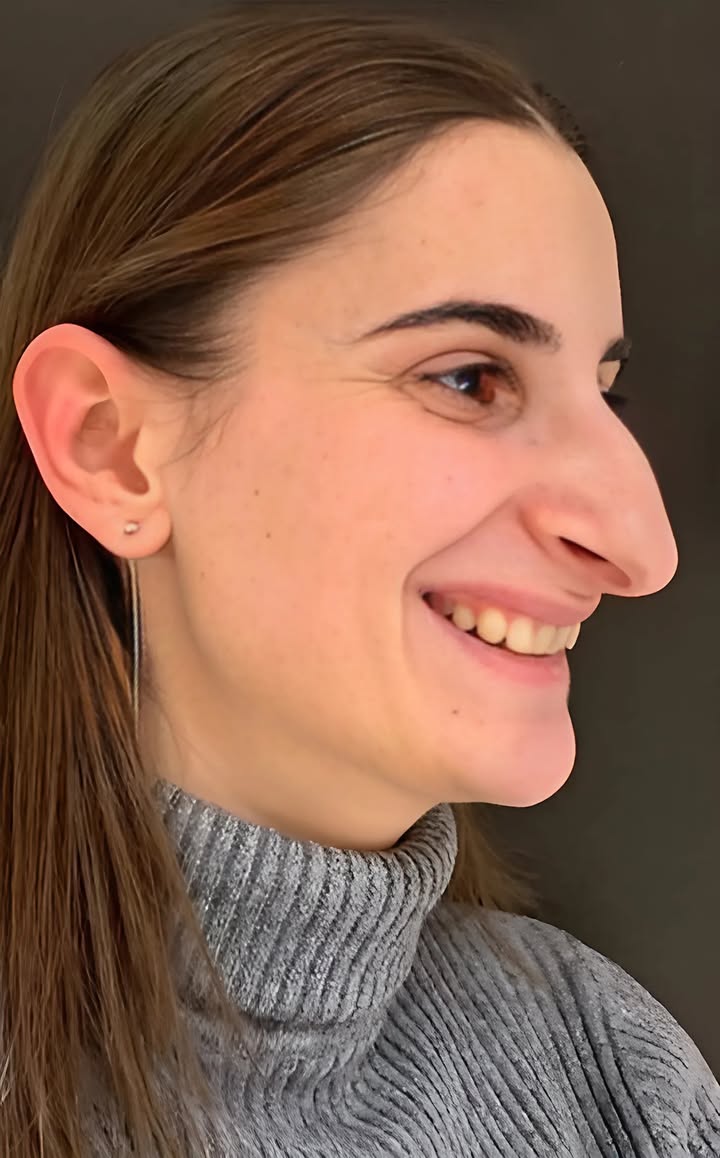
What happens during a rhinoplasty?
The surgeon will photograph and examine your nose from all angles, including the inside. Morphing gives you a good idea of what's possible: the shape is simulated on your front and profile photos, or on a computer using 2D or 3D software. The surgeon will explain the procedure, which is most often performed under general anesthesia, and the recovery process. They may choose to reshape the nose using a closed technique, making incisions through the nostrils, or an open technique, which will leave a small scar at the base of the nose, and on the nostrils if they are also involved. In some rarer cases, chin correction may be necessary. Never hesitate to get a second opinion. Plan to stay home for two weeks and use good, concealing makeup.
“I was feeling great the night of the operation. I kept some strands of hair in my nose for a day, and they removed the bandage a week later,” says Sarah, 27, who had the surgery six months ago. “I was a little apprehensive, but I immediately had an idea of the result. My eyes were swollen and I had bruising for a month. That’s part of the process; I camouflaged it as best I could. I still can’t feel my nose 100%, but it wasn’t painful. It’s so well done! People who don’t know I had the surgery ask me what I did to my hair…”
Is ultrasonic rhinoplasty better?
Tested for two years, it will be presented at the congress of the French Society of Plastic, Reconstructive and Aesthetic Surgery in December. "It involves reshaping the bony part of the nose using ultrasonic instruments smaller than traditional tools," explains Dr. Olivier Gerbault, a plastic surgeon. The advantage?
"We are more precise, which reduces the risk of breaking the bone in the wrong place when we need to. And, since it doesn't damage the skin or blood vessels, the recovery is shorter," he adds. The disadvantage: the procedure takes longer, and therefore costs more (see the table below). The ongoing study will also need to clarify its benefits, limitations, and risks. Until interested specialists are trained, sometime in 2015, traditional rhinoplasty remains the gold standard.
continued on the next page